wireless vs wired

Saying the quiet part out loud: Wireless Charging Is a Physics Tax We’re Pretending Not to Pay

Wireless Charging Is a Physics Tax We’re Pretending Not to Pay

There is a growing push to make more and more things “wireless,” including something as energy-intensive as charging. On the surface it looks like progress. In reality, it is a deliberate choice to make our energy systems less efficient in exchange for small personal convenience — and that inefficiency is now large enough to matter at infrastructure scale.

We are entering a world constrained not by cleverness, but by physical limits: power generation, grid capacity, cooling, materials, and permitting. In that world, efficiency stops being a nice-to-have and becomes infrastructure.

This is a systems-level engineering problem, not a gadget problem — something we regularly deal with in embedded and hardware design work
https://www.endvr.com/embedded-systems-design


Wireless Charging Is Fundamentally Less Efficient

Wired charging is simple physics: direct conduction through copper with minimal conversion steps. In practice, wired charging routinely achieves 90–99% efficiency from wall to device, depending on power electronics and cable quality
https://www.ti.com/power-management/overview.html

Wireless charging requires:

  • Converting electrical power into oscillating magnetic fields
  • Transmitting those fields through air gaps, shielding, and misalignment
  • Converting those fields back into electrical power

In practice, inductive wireless charging for consumer devices typically achieves 70–80% efficiency under good conditions — meaning 20–30% of the input energy is lost as heat in coils, shielding, and surrounding materials
https://www.anker.com/blogs/chargers/how-efficient-is-inductive-charging

This is not a software problem or a maturity problem. It is basic electromagnetics, well covered in IEEE literature
https://spectrum.ieee.org/wireless-power-transfer

You can improve coupling. You can optimize coils. You cannot make inductive transfer more efficient than direct conduction.


“It’s Only a Few Watts” Is How You Miss the Point

A typical wireless phone charger delivers about 10 W to the device.

At 80% efficiency, that means 2 W is wasted as heat per device while charging.

Now multiply:

  • 2 W wasted per device
  • ~1 billion wireless-charged devices globally
  • ~2 hours of charging per day

That equals:

  • ~2 gigawatts of waste power while charging is happening
  • ~4 gigawatt-hours wasted per day
  • ~1.5 terawatt-hours wasted per year

That is roughly the annual electricity usage of a mid-sized city — spent doing nothing but heating coils and air.

This kind of scaling effect is exactly how “small” inefficiencies turn into infrastructure problems, a pattern that shows up across modern technology systems
https://www.endvr.com/technology-and-infrastructure


Scaling Turns Convenience Into Infrastructure

At phone scale, the loss is invisible.
At global scale, the loss becomes:

  • More generation capacity
  • Thicker distribution networks
  • More cooling load
  • More urban heat
  • More environmental impact

And this is before we talk about laptops, tools, robots, appliances, or cars.

Wireless charging for electric vehicles is now being standardized, with claimed efficiencies approaching the mid-80% range under ideal alignment — still meaning meaningful loss at multi-kilowatt power levels
https://www.energy.gov/eere/vehicles/articles/wireless-charging-electric-vehicles
https://www.sae.org/standards/content/j2954_202010/

At that scale, wireless charging is no longer consumer electronics. It is embedded industrial heating.


Physics Does Not Negotiate

There is a persistent belief that “technology will fix it.”

Technology can reduce loss.
It cannot remove it.

Inductive coupling will always be worse than conduction.
Radiative transfer will always be worse than guided transfer.
Higher power density will always mean more heat
https://www.analog.com/en/analog-dialogue/articles/efficiency-in-power-supplies.html

No amount of software, AI, or clever optimization changes that.


The Real Question

The question is not whether wireless charging is possible.

We can do almost anything with enough money and steel.

The real question is whether eliminating a cable is worth:

  • More power plants
  • More grid upgrades
  • More cooling infrastructure
  • More waste heat
  • More systemic fragility

As data centers, electrification, and AI already strain grids globally, these tradeoffs are becoming unavoidable
https://www.iea.org/reports/electricity-2024/data-centres-and-electricity-demand
https://www.eia.gov/energyexplained/electricity/


The Point

Wireless charging is not evil.
It is not impossible.
It is simply inefficient.

In a world where energy and infrastructure are the limiting factors, inefficiency is no longer just a design choice — it is a public systems decision.

Progress is not making everything wireless.

Progress is doing necessary things with less waste.

ChatGPT Image Dec 2, 2025, 07_36_43 PM

Saying the Quiet Part Out Loud: Open-Source Software Isn’t What People Think It Is

Why “free” software often becomes the most expensive mistake your team can make.


People repeat the same tired lines: “It’s free.”, “It’s community-driven.”, “It’s good enough.”

That’s myth, not reality. In professional environments where time-to-market, reliability, and accountability matter, open-source software is often the weakest link in the chain — and nobody wants to say it out loud. Let’s actually say it.


Open-Source Isn’t Built for the Demands of Real Product Teams

Open-source thrives in hobby circles, academic labs, and side projects. But the moment you rely on it inside a real business — where deadlines, uptime, customer experience, and revenue depend on stability — the cracks show fast.

Commercial tools offer what OSS simply cannot guarantee:

  • Predictable updates
  • Dedicated support teams
  • Accountability
  • Professional QA and compliance
  • Long-term stability

Open-source maintainers don’t owe you anything. Commercial vendors do. That difference is everything.


Can We Please Stop Calling Open-Source “Free”?

The license is free. The real costs begin the moment something breaks.

And with OSS, things will break:

  • Dependency hell
  • Abandoned maintainers
  • Breaking API changes
  • Missing security patches
  • “Works on one distro, fails on another” madness
  • Engineers burning days or weeks stabilizing tools

The moment your team hits a snag, the dollar clock starts running — at full speed.

And nothing burns money faster than “free software” your senior engineers must spend a week debugging. In fact, in all likelihood, you will need a few engineers dedicated to supporting your free tools. Recruiting, bonus, office space, equipment. Not so free all of a sudden, is it?


OSS in High-Pressure Environments = Homemade Tools in an F1 Pit Crew

Imagine telling an F1 pit crew — the fastest, most precise mechanics in the world — to service a $12M race car using:

  • A torque wrench built by hobbyists
  • A jack from an amateur project group
  • An impact wrench maintained “whenever someone feels like it”

Nobody would approve that, because in high-performance environments:

  • Precision matters
  • Repeatability matters
  • Accountability matters
  • Time matters

OSS might be clever. It might be fun. It might even be elegant. But when time to market is non-negotiable, homemade tools don’t cut it. Not in racing, and not in business.


If OSS Was a Plane, Nobody Would Get On

The song If Love Was a Plane captures the feeling perfectly:

“Folks, thanks for flyin’ with us —
But there’s a six-in-ten chance we’re goin’ down.”

A 60% chance of failure and the pilot announces it. Would you board?

Now look at open-source through that lens.

There aren’t a handful of Linux distros. Not a couple dozen. Not even a hundred. There are hundreds — depending on how you count, 600+.

Official list:
https://en.wikipedia.org/wiki/List_of_Linux_distributions

This is what software fragmentation looks like.

Ask yourself:

  • Can every one of these distros be secure and well-tested?
  • How do you know which will still exist in three years?
  • Will your product survive if the distro you picked dies halfway through your development program?
  • What happens when your maintainer burns out and walks away? Or they can’t solve the problem?

Choosing OSS is similar to jumping on plane after the pilot warns that 6 out of 10 flights don’t make it.

Would you buy the ticket? Would you get on?


Engineers Love to Tinker — And It Kills Time-to-Market

Here’s the part engineers hate hearing: Most engineers don’t focus on shipping. They focus on tinkering. On solving problems. But that’s not what makes us money. Shipping product is what keeps the lights on.

They:

  • Rebuild environments
  • Explore new distros
  • Refactor for fun
  • Over-optimize
  • Invent tools nobody asked for
  • Lose weeks chasing elegance instead of delivering product

And afterward, their justification is always the same:

  • “I learned a lot.”
  • “It was a fun challenge.”
  • “This custom setup is really cool.”

None of that matters.

None of that ships product. None of that hits deadlines. None of that produces revenue.

Meanwhile, the engineers who do understand time-to-market behave like F1 mechanics:

  • Fast
  • Disciplined
  • Focused
  • Zero reinvention
  • Zero vanity projects
  • Zero drama

They use the right tools. They avoid distractions. They ship. Those are the engineers I want on my team. How about you?


The Truth

Open-source isn’t evil. It’s not useless. And it’s not going away.

But let’s stop pretending:

  • Open-source is a gamble.
  • Commercial tools are a commitment.
  • Open-source encourages tinkering.
  • Commercial tools require discipline.
  • Open-source shifts cost into chaos.
  • Commercial tools shift cost into predictability.

When your business depends on reliability, deadlines, honest schedules, and real-world product launches…

You don’t board a plane with a six-in-ten chance of going down — no matter how “free” the ticket is.

ThreadX Alliance

RISC-V meets ThreadX

Wouldn’t it be interesting if RISC-V meets ThreadX? Integrating RISC-V open-source hardware with the ThreadX real-time operating system (RTOS) offers a powerful solution for embedded system developers. This combination leverages the customizable nature of RISC-V processors with the efficiency and reliability of ThreadX, facilitating the creation of high-performance, tailored applications.

Technolution Advance has successfully ported ThreadX to a RISC-V softcore processor implemented on an FPGA, demonstrating the feasibility and benefits of this integration. This port provides developers with a ready-made RTOS for the RISC-V architecture, easily deployable on FPGA platforms.

Technolution

Additionally, the Eclipse Foundation has been instrumental in bringing together open-source hardware and software communities. Their efforts have facilitated collaborations that enhance the development ecosystem for technologies like RISC-V and ThreadX, promoting innovation and interoperability.

Eclipse Foundation Blog

For developers interested in this integration, resources are available to guide the porting process. For instance, a GitHub repository details the steps to port ThreadX to the RISC-V64 architecture, providing valuable insights and code samples.

GitHub

By combining RISC-V’s open-source hardware flexibility with ThreadX’s robust RTOS capabilities, developers can create efficient, scalable, and customizable embedded systems tailored to specific application requirements.

For a deeper understanding of porting ThreadX to RISC-V, you might find the following presentation informative:

esp32

Start your New Year with an ESP32 Project!

3 Exciting ESP32 Projects to Ring in the New Year

The New Year is the perfect occasion to explore creative projects with the ESP32 microcontroller. Here are three ideas to add a high-tech twist to your celebrations:

  1. LED Countdown Timer:
    Create a stunning countdown timer using an ESP32 and an addressable LED strip like WS2812B. Display numbers and animations that count down to midnight. Integrate a real-time clock (RTC) module or use NTP time syncing to ensure accuracy.
    Learn more here.
  2. Fireworks Simulation:
    Simulate dazzling fireworks with the ESP32 and RGB LED panels. Program the LEDs to create bursts of color and motion that mimic fireworks, synchronized to music. This project is a fun and safe way to add some sparkle indoors.
    Check it out here.
  3. IoT Resolution Tracker:
    Start the New Year organized with an ESP32-powered resolution tracker. Use an OLED display to list goals and mark them complete via a connected app or physical button. Pair it with Firebase or another database for progress tracking.
    Get started here.

These projects combine technology with the festive spirit, helping you start the year on a creative note!

ChristmasTree

DIY Christmas Tree Projects

The holiday season is an excellent opportunity to engage in festive DIY electronics projects using the versatile ESP32 microcontroller. Here are three creative ideas to inspire your holiday tinkering:

  1. DIY Christmas Tree with ESP32 and Blynk App: Create a simple IoT-enabled Christmas tree by combining an ESP32 board with WS2811 Pixel LEDs. You can utilize the Blynk app to control the lights remotely, allowing you to change colors and patterns from anywhere. This project is cost-effective and perfect for beginners. Sritu Hobby
  1. Interactive Christmas Tree with WLED: Design an interactive Christmas tree using an ESP32 D1 Mini and ping pong balls as diffusers for the LEDs. You will employ the WLED platform to manage lighting effects, offering a wide range of customizable animations synchronized with your festive décor. WLED Community
  1. Smart Christmas Tree with Alexa Integration: Enhance your holiday setup by building a smart Christmas tree controlled via Alexa. Connect an ESP32 to RGB lights and configure it with the WLED app. By enabling Alexa voice control, you can effortlessly manage your tree’s lighting, creating a seamless and modern festive experience. Hackster.io

These projects not only add a personalized touch to your holiday decorations but also provide a hands-on way to explore IoT and smart home technologies.

For a visual guide on creating a DIY Christmas tree with an ESP32 board and Blynk app, you might find the following video helpful:

ThreadX Alliance

The ThreadX Advantage: Why Choose ThreadX Over FreeRTOS?

When it comes to real-time operating systems (RTOS) for embedded systems, developers face numerous options. As a proud ThreadX Alliance Member, Endeavor Consulting Group is uniquely positioned to highlight the advantages of ThreadX over competing solutions like FreeRTOS.

Proven Performance and Reliability

ThreadX has established itself as a leader in the RTOS space. Its robust and mature codebase is deployed in billions of devices worldwide. With deterministic performance and low latency, it excels in applications where timing is critical. In contrast, FreeRTOS often lacks the fine-tuned optimization found in ThreadX, especially in demanding environments.

Ease of Use

ThreadX features a simple API and well-structured architecture, enabling developers to get up to speed quickly. This reduces time-to-market. Its integrated event-chaining system and rich debugging support make development more efficient and less error-prone.

Scalability and Features

ThreadX offers built-in support for advanced features like real-time event chaining and preemption thresholds. These simplify complex real-time applications. While FreeRTOS provides a modular approach, implementing similar features often requires third-party extensions or custom development. This can increase complexity and maintenance.

Commercial Support and Certification

Backed by Azure RTOS, ThreadX provides robust commercial support and comprehensive documentation. It’s also certified for safety-critical applications in industries like automotive and medical devices. FreeRTOS, being open-source, often relies on community support, which may not suffice for mission-critical projects.

Conclusion

Choosing the right RTOS is a foundational decision for any embedded project. With superior performance, ease of use, and a rich feature set, ThreadX consistently outshines FreeRTOS. At Endeavor Consulting Group, we leverage our ThreadX expertise to help businesses build next-generation embedded solutions. Contact us to learn how ThreadX can transform your project!


Key Features of ThreadX vs. FreeRTOS:

  • Performance: ThreadX offers deterministic performance with low latency.
  • Features: Built-in advanced tools streamline real-time applications.
  • Support: Commercial-grade support ensures reliability.
  • Certification: Certified for safety-critical applications.

Check out this video to learn more about the advantages of ThreadX: Watch Now

USB Cables

USB-C: Beyond Data Transfer – Revolutionizing Modern Connectivity

In the dynamic realm of modern technology, the quest for smaller and more portable computing devices has reshaped the landscape of connectivity. As devices shrink in size, the demand for compact connectors capable of supporting increasing data rates has become more pressing than ever. USB Type-C (USB-C) stands at the forefront of this transformative shift, redefining connectivity by going beyond conventional data transfer and delivering a host of functionalities that empower and enhance the capabilities of modern computing devices.

The Proliferation of Small Form-Factor Devices

The relentless drive towards sleek, lightweight, and portable devices has given rise to an era of small form-factor gadgets. Laptops are thinner, tablets are lighter, and smartphones have become almost borderless. Yet, as devices continue to shrink, the need for connectors that can match these dimensions without sacrificing performance has become a pivotal concern.

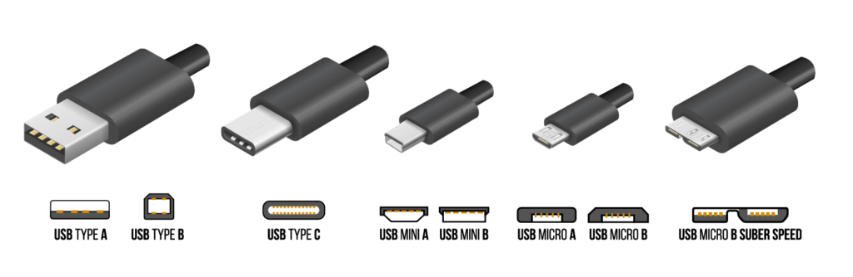
USB-C emerges as the solution to this challenge, representing a paradigm shift in connector design. Its compact and symmetrical form factor, with dimensions as small as 8.4mm by 2.6mm, not only addresses the physical constraints of smaller devices but also eliminates the frustration of attempting to insert the cable the wrong way – a common inconvenience with older USB connectors.

USB Power Delivery (PD): Empowering Devices with Maximum Power

At the heart of USB-C’s transformative power lies its ability to transcend the confines of traditional data transfer. While USB-C certainly excels at high-speed data transfer, its capabilities extend far beyond this singular function.

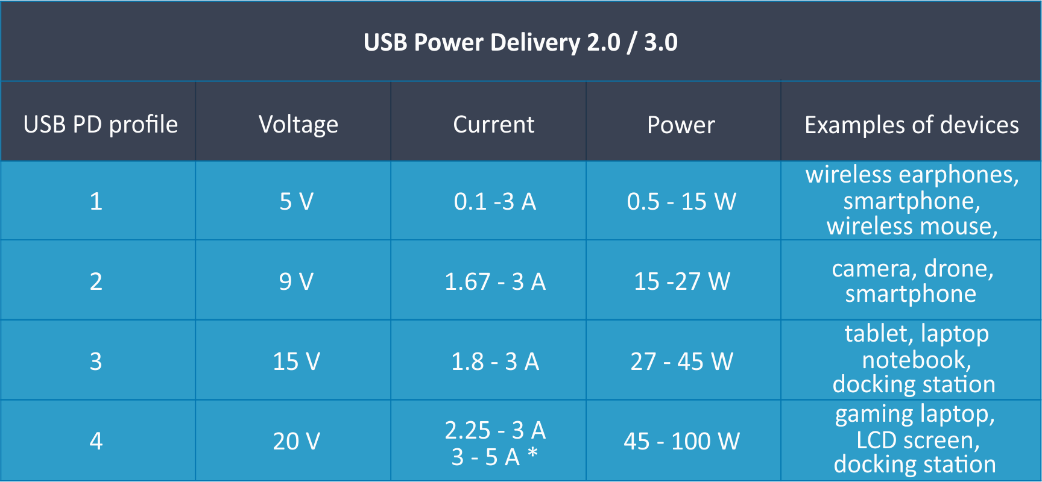
USB-C supports the USB Power Delivery (PD) specification, allowing connected devices to negotiate power levels. This means that USB-C is not just a conduit for data transfer; it’s a powerhouse capable of delivering substantial power. With USB PD, USB-C can handle power delivery of up to 240 watts, making it an ideal choice for charging laptops, tablets, and other power-hungry devices.

USB-C’s power delivery capabilities make it possible to standardize charging across various devices. Whether you’re charging your laptop, tablet, or smartphone, a single USB-C cable can efficiently handle the task. This uniformity simplifies cable management and reduces the need for multiple chargers, contributing to a more streamlined and user-friendly experience.
Power Delivery — was ist das?

Conclusion: USB-C – A Revolution in Power Delivery

In conclusion, USB-C stands as a beacon of innovation, transforming the landscape of modern connectivity. As devices continue to shrink, USB-C goes beyond the conventional role of data transfer, becoming a versatile powerhouse that delivers power, efficiency, and expanded connectivity options. USB-C not only addresses the challenges posed by smaller form-factor devices but propels modern computing into an era where a single connector fulfills a multitude of functions. From charging laptops to connecting to various peripherals, USB-C is the unifying force that drives efficiency, simplicity, and a seamless user experience in the world of modern technology.