
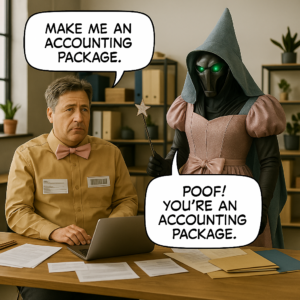
I pay about $2,200 a year for QuickBooks for a small boutique design firm, real mom-and-pop backbone-of-America kind of business.
I was getting ready to move to Zoho Books for about $200 a year. That already felt like a familiar software story, basically the Innovators Dilemma. The incumbent had grown broad, expensive, and full of things I don’t need. Sometimes less is more, and this is one of those times. The cheaper product looked closer to fit.
Then the more interesting thought showed up.
Why am I choosing between QuickBooks and Zoho Books at all?
Why wouldn’t I sit down with AI and make the small-business accounting package I actually want?
For a company our size, this isn’t some mysterious frontier problem. It’s invoices, expenses, reconciliations, categorization, reporting, and a clean path into tax prep. It’s old art. If I can get a usable version of that working in the same amount of time it takes to migrate data, learn a new tool, and adapt myself to somebody else’s workflow, the buying decision changes.
That should make a lot of SaaS companies nervous.
## The threat is not just a cheaper competitor
The usual software fear is that a rival shows up with a lower price, a cleaner UI, or a better distribution trick.
AI creates a different problem.
The customer may decide the category is no longer hard enough to rent.
That doesn’t mean every company should go build its own general ledger. Context still matters. Audit requirements matter. Payroll complexity matters. Bank integrations matter. Bad accounting software can hurt you in very boring and very expensive ways.
The point is narrower than that. The thought itself has become rational.
For a long time, buy versus build was a serious tradeoff. Building even a modest internal tool meant real engineering time, real delivery risk, and real maintenance burden. A lot of companies were right to rent software they didn’t love because building their own version was worse.
Now there is a third option: generate.
## This is already happening
The strongest signal here isn’t my QuickBooks bill. It’s that the market is already moving in this direction.
Microsoft announced Word, Excel, and PowerPoint Agents on November 18, 2025. That matters because even the most familiar productivity software is starting to shift from “open the app and operate it” toward “describe the result and let the system assemble it.”
Retool said on February 17, 2026 that 35% of surveyed teams had already replaced at least one SaaS function with a custom-built solution, and 78% planned to build more custom tools in 2026. That’s not a toy use case. That’s organizations deciding that at least part of the old buy decision doesn’t pass the laugh test anymore.
When Wix acquired Base44 on June 18, 2025, Base44’s CEO said the market had the potential to replace entire software categories by enabling people to create software instead of buying it. That’s how one of the companies in this market is describing the opportunity out loud.
Once that logic becomes believable, a lot of software categories get weaker very quickly.
## The vulnerable software is usually the boring software
The first products at risk are not the ones with the hardest computer science. They’re the ones with the narrowest actual job.
If the workflow is well understood, the rules are mostly known, the business context is local, and the incumbent product is bloated relative to the need, the category becomes a candidate for recreation.
Small-business accounting is one example.
Internal approval flows are another. So are reporting portals, partner dashboards, CRM sidecars, quoting tools, quality logs, lab workflows, and all the other pieces of business software that became expensive mostly because somebody had to package them, host them, and drag a broad market onto one product surface. Software has spent twenty years turning simple chores into subscription cuisine.
Those categories used to be safe because the build cost provided a barrier to entry. AI is filling in that moat, and fast.
## The moat moves from features to trust
This is where a lot of incumbents are going to lie to themselves. Adding a chat panel to old software is not the defense. That’s not reinvention. That’s taping a chatbot to the vending machine and calling it a chef.
The product doesn’t keep winning because it has more screens than the generated alternative. It keeps winning if it owns something harder to recreate: trust, compliance, auditability, ecosystem position, liability, data gravity, or a failure mode the customer genuinely doesn’t want to own.
That’s the new line. If your moat is “we already built all these forms,” you should be worried.
If your moat is “we are the system of record for a consequence-heavy process with hard external requirements,” you may be fine for a lot longer.
## This matters far beyond accounting software
I don’t think the long-term story here is everybody rebuilding QuickBooks from scratch, mostly because when I’m done with mine, I’m going to give it away.
I think the long-term story is that technical leaders will start asking these questions about a lot more categories:
Should we buy this?
Should we build this?
Or should we generate the narrow version we actually need?
That question is going to show up all over product companies, especially around internal workflows that sit beside the real product: manufacturing handoffs, test reporting, validation dashboards, failure triage, release packaging, compliance evidence, field-service workflows, and a hundred other ugly little systems teams tolerate because buying them was easier than owning them.
That math is changing. The software industry spent years training customers to compare vendors. AI may train them to compare vendors against a generated substitute.
That’s a different problem.
## Before Renewal Season Answers for You
If you are still paying enterprise-style prices for narrow internal workflows, talk with Endeavor (https://www.endvr.com/contact/) before you sign another renewal your team could now generate around.