
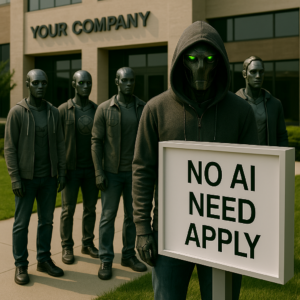
Every company has a talent strategy. Some choose it. Some just get it by veto.
A blanket AI ban is one way to get it by veto.
I understand why companies do it. If you’re the CEO, the general counsel, or the CISO, “no AI allowed” can feel like the prudent move. Nobody will paste sensitive code into a public tool. Nobody will drop customer data into a chatbot. The company avoids one obvious class of legal, security, and compliance problems before someone creates them in the name of productivity.
That instinct isn’t stupid. It also isn’t free.
What Engineers Hear
Most leaders think of a blanket AI ban as risk control. Many engineers read it differently. They read it as a signal that the company is afraid of a new tool category it doesn’t yet know how to govern. They read it as a place where legal and IT get veto power over technical evolution, and where stopping learning feels more acceptable than learning under constraints.
That matters because strong engineers are not looking for a workplace that feels safe in the shallow sense. They know these tools have risks, they know the market is moving, and they know competitors are learning. The question for them is usually not whether to pretend this is not happening. It’s how to use it without being idiots.
A company that can’t answer that question doesn’t look disciplined. It looks behind.
Retention Gets Hit First
That has consequences for retention first. The people most likely to leave are usually not the ones you can most afford to lose. They’re the curious ones. The people who experiment early, who want to build judgment while the tools are still uneven, and who understand that organizational learning doesn’t magically appear later on command. They can tolerate constraints. What they won’t respect is institutional paralysis dressed up as maturity.
If those people conclude your company’s official strategy is fear, some of them will leave for places that are handling this like adults.
Then Recruiting Starts to Rot
The recruiting cost is right behind it. A blanket AI ban increasingly tells candidates that your company is going to be late. Maybe late on tooling. Maybe late on process. Maybe late on the next shift too. Even cautious candidates can tell the difference between a company with approved tools, clear rules, and sane boundaries and a company whose policy is just “absolutely not.” One sounds governed. The other sounds brittle.
That difference matters if you’re trying to hire ambitious technical people, especially the ones who are good enough to have options.
Culture Follows Policy
Then culture starts to drift. Once total prohibition becomes the answer, curiosity starts looking like noncompliance. Experimentation starts looking political. The people asking whether the policy still makes sense become a process problem. Over time that changes who stays, who gets promoted, and what kind of technical organization the company turns into. You don’t have to announce that you’re building a slower, more fearful engineering culture. You can back into it quite naturally.
This is why I think blanket AI bans are really talent bans.
Not because every good engineer wants unlimited access to every model on earth. Most don’t. Serious engineers understand data sensitivity, IP risk, and regulatory exposure better than many executives do. They are not asking for chaos. They’re asking whether the company they work for is capable of governing a new tool without panicking, learning in bounded ways, and trusting competent adults with clear constraints.
If the answer is no, they learn something important about the place.
The Ban Often Fails Anyway
There is a more embarrassing version of this too. Blanket bans often fail on their own terms. People still experiment on personal devices, in unsanctioned accounts, outside reviewable systems. Then the company gets the worst of both worlds: no institutional learning, no sanctioned process, and still some unmanaged risk. That isn’t control. It’s theater.
I am not arguing that every company should throw the doors open. Some environments should be strict. Some data should never touch external systems. Some use cases should be blocked outright. Adult supervision is real.
What I am arguing is that a blanket ban is rarely a durable strategy. Usually it’s a placeholder where governance should be. It may reduce some immediate risk, but it also tells your best people something you probably did not mean to say: this company would rather freeze than learn. In a market already sorting itself by speed, judgment, and adaptability, that message gets expensive fast.
Before “No AI Used Here” Becomes Your Recruiting Brand
If your AI policy is really a substitute for governance, talk with Endvr before your best engineers decide they’d rather learn somewhere else.