
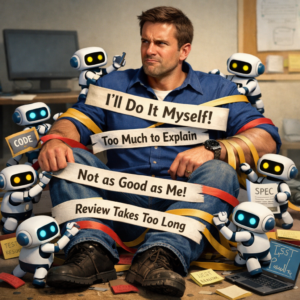
AI is shifting engineering away from pure individual problem-solving and toward defining, directing, and reviewing work. Engineers who resist that shift for the same reasons they resist delegating will struggle to adopt AI effectively.
A lot of leaders still talk about AI as if it were just another productivity tool. It is not. AI is delegated work. Delegated work has to be defined, scoped, assigned, reviewed, corrected, and kept on track.
That is the problem.
The engineers who say, “I can do it faster myself,” about junior staff are often the same ones who fail with AI. The problem is not the tool. The problem is resistance to delegation, review, and managed work.
For years, many engineers were able to stay close to the work and avoid much of the management side of things. AI changes that. To use it well, they have to define the task clearly, provide the right context, set boundaries, review output, catch drift, and iterate. That is part project management and part people management, even if the “person” doing the work is now a machine.
Many engineers hate that.
They did not become engineers to assign tasks, define scope, write specs, review mediocre output, chase ambiguity, and manage iteration loops. They became engineers to solve hard problems directly. When AI starts changing the job from direct execution to directing work, resistance should not surprise anyone.
That resistance will slow adoption. It will reduce leverage. It will make it painfully obvious which engineers can adapt and which ones cannot.
Some of the resistance is practical. Some of it is fear. A few engineers look at AI and think, “Why would I help build the thing that may replace me?” That fear is not always said out loud, but it sits underneath a lot of slow adoption. More on that in my next post.
So what should a VP do?
Do not send your team to a fluffy prompt-writing seminar and hope for the best. Train them in the parts of leadership they have often avoided: defining work clearly, supplying context, setting constraints, reviewing output, and correcting drift. In other words, if you want engineers to work well with AI, train them less like solo problem-solvers and more like technical leads.
Endeavor can help with that. We work with teams in-house, personally, and practically, focused on real engineering workflows instead of AI theater.
Give us a call.