
This week, I watched a video of someone building a small, very cute desk robot. It had blinking eyes, a personality, and a way of talking that reminded me of Rocky from Project Hail Mary.
I took two 20-second clips from the videos, gave them to my AI agent, and said: “I like this. I want one.”
That was it.
No requirements document. No measurements. No conversation about mechanisms, materials, electronics, constraints, or behavior.
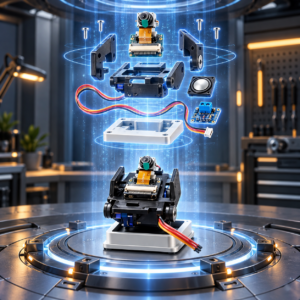
About two hours later, it had produced mechanical designs, STL files, and a STEP file. I loaded the STEP file into Fusion. It was almost perfect.
It created a bill of materials: PC boards, resistors, wire, screws, brass inserts—the whole list. It began the firmware, got facial recognition working, and made the eyes on the display blink.
The Video Was the Specification
The striking part was not that it generated CAD files. We have been expecting that.
The striking part was that it looked at a short video and inferred the size, form, functionality, mechanics, electronics, personality, and build approach well enough to create a coordinated first pass.
The video was the specification.
Traditionally, physical products move through a chain of interpretation: someone sees an idea, someone writes requirements, mechanical design begins, electrical design follows, firmware follows, and sourcing follows. Every handoff costs time and loses context.
That chain just got much shorter.
Every Product Demo Is Now an Input
For companies that show their products online, this matters. A product demo is no longer only marketing material. It can become an input.
A customer can ask for an adaptation. A partner can ask for a compatible component. A competitor can ask for an approximation.
The moat shifts toward what cannot be seen in a video: proprietary performance, data, supply chains, manufacturing discipline, service, brand, and speed of execution.
We are not at a Star Trek replicator yet. But the gap between “I saw something I want” and “here are the files and instructions to build it” has collapsed far faster than most people realize.
If your team is thinking about what AI changes in physical products, engineering workflows, or product differentiation, talk with Endvr.